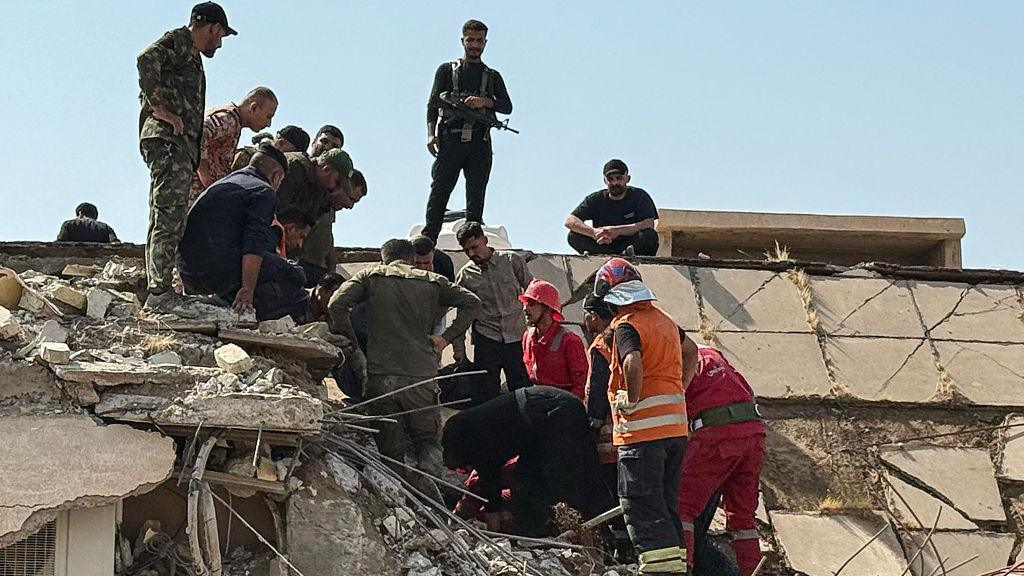

Iraqi security and emergency personnel work at the scene of a strike in Muqdadiyah, Diyala province on Wednesday
Saudi Arabia and the US have carried out strikes against Iran-backed militias in Iraq, in a potential escalation of the Middle East conflict.
US Central Command (Centcom) said the strikes were against "Iran-aligned terrorists that the Islamic Revolutionary Guard Corps (IRGC) directed to attack US forces and Saudi energy infrastructure".
Iraq's paramilitary Popular Mobilisation Forces (PMF), which is dominated by Iran-backed Shia militias, said at least 20 of its members had been killed in US-Saudi strikes on its bases.
It came hours after Centcom said Iran had launched missiles at US forces in the Middle East in an "attempted surprise attack", ending a lull in hostilities.
The US said the Iranian attack occurred at 17:45 EDT (21:45 GMT) on Tuesday, with all missiles "successfully intercepted".
The IRGC said it had targeted a US air base and a command centre in Jordan "in response to the acts of aggression of the American child-killing army".
It also said that naval forces had struck three oil tankers in the Strait of Hormuz after they "ignored warnings" and sailed along what it described as an "unsafe and illegal route" through the vital Gulf waterway.
When asked by a Fox News correspondent on Wednesday about the Iranian attack on Jordan, US President Donald Trump said in an expletive-laden response that US forces would be "hitting them hard", adding: "They're going to get a beating."
Centcom said the joint US-Saudi strikes hit "multiple terrorist logistics and weapons sites across eastern Iraq in a strong response to over 30 IRGC-directed aerial drone attacks in the last 72 hours".
It called the drone attacks "unwarranted" and added that they had failed.
"The IRGC and its terrorist proxies must cease these attacks to avoid further US military response," the Centcom statement said.
A spokesman for the Saudi defence ministry, Maj-Gen Turki al-Maliki, also accused "Iran-backed terrorist militias" of launching drones from Iraqi territory at oil facilities in the Eastern and Riyadh regions on Monday and Tuesday.
He said Saudi Arabia, under its "right to self-defence", had responded by conducting strikes "against specific targets belonging to those militias".
"The Kingdom of Saudi Arabia reiterates that it does not seek escalation but will respond decisively to any aggression directed against it," he added.
The PMF said in a statement on Wednesday morning that at least 20 of its fighters had been killed and 32 others wounded in US-Saudi strikes on a number of its headquarters in the provinces of Baghdad, Wasit, Nineveh, Basra, Kirkuk, Karbala and Diyala.
An official told AFP news agency that the strikes in Nineveh, in the north, and in Diyala, in the centre, were the deadliest.
The PMF condemned what it called "the treacherous terrorist attacks", saying they were "an extremely serious escalation and a violation of Iraq's sovereignty, targeting its official security institutions".
The PMF is an umbrella organisation of mostly Shia Muslim militias that has been formally integrated into the Iraqi armed forces. It includes several Iran-backed groups that are part of a network of proxies that Tehran has used to advance its interests across the Middle East for years.
Those militias have attacked US personnel and interests in Iraq on a number of occasions, aiming to force the remaining US troops to leave the country. The US has regularly struck back at the militias.
The Iraqi presidency said it denounced the bombing of the PMF bases, calling it "an unacceptable attack and a blatant violation of Iraq's sovereignty, targeting its official institutions".
However, Trump told Fox News that the strikes had been "co-ordinated with the Iraqi government".
Iran's foreign ministry also condemned the strikes on Iraq, saying they were a "gross violation" of international law. It also claimed that they were part of a US-Israeli strategy to "expand the war" in the Middle East, and warned that the US and "its accomplices" would be responsible for any "dangerous consequences".
Members of Popular Mobilisation Forces took part in funeral ceremonies for Iran's late supreme leader in Iraq
Saudi Arabia, which sees itself as the leading Sunni Muslim power, and Iran, the largest Shia Muslim country, have been locked in a struggle for regional dominance for decades. However, their rivalry has been exacerbated in recent years by proxy conflicts across the Middle East, including Yemen, Syria, Iraq and Lebanon.
The two countries restored diplomatic ties in 2023, but Saudi Arabia has been angered by repeated Iranian missile and drone attacks on its territory during the Iran war, which have targeted US military facilities there as well as energy infrastructure.
Yemen's Iran-backed Houthi movement also began launching attacks on Saudi tankers in the Red Sea and Saudi oil facilities earlier this month, saying it was retaliating for what it said were Saudi air strikes on Sanaa's airport.
The reignited hostilities between the US and Iran come two days after President Donald Trump spoke of "very friendly negotiations" to resolve a dispute over the Strait of Hormuz. At that point, the two sides had not exchanged strikes for three consecutive days.
The lull had followed 13 consecutive nights of bombing by the US, which said it had targeted Iranian weapons and military sites to diminish Iran's ability to attack commercial vessels attempting to transit the strait. Scores of people were reported to have died in the strikes.
Iran responded to the US attacks by launching missiles and drones at US military assets in neighbouring Arab states. Four US service personnel were killed Jordan and Iraq.
Access to and control of the Strait of Hormuz remain a key sticking point in negotiations between the US and Iran, which Iranian officials have denied are even happening.
Oil prices rose on Wednesday over concerns that an escalation in the conflict could further disrupt energy shipments through the strait, which has been effectively closed since the start of the US and Israel's war with Iran at the end of February.
The global benchmark Brent crude was up 5% to $88.50 per barrel.
The latest strikes coincided with Israeli Prime Minister Benjamin Netanyahu's visit to Washington, where he met Trump at the White House and attended the funeral of US Senator Lindsey Graham, a prominent Iran hawk.
More than 600 US military service members injured since Iran War began in February
As the US pauses the war with Iran, is Trump really running out of weapons?